
Walking Quito's Historic Center: The Complete Guide
Start at Plaza Santa Clara. Walk 400 years of colonial history, pre-Columbian art, and neighbourhood life. A guide from inside the route.
Read more
%201.svg)

.svg)
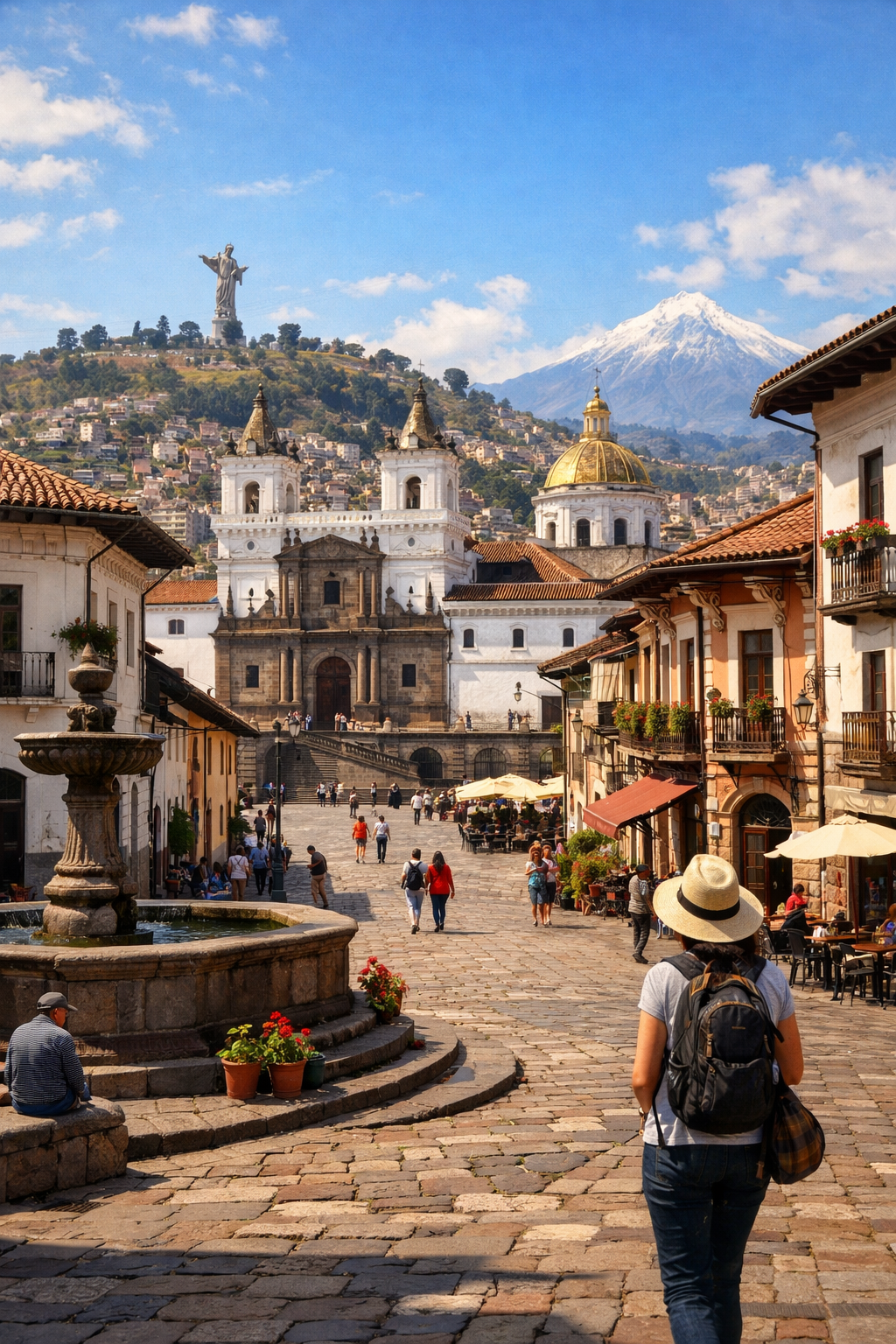
At ten past eight on an ordinary Tuesday morning, the bells of the Santa Clara Monastery ring across the plaza. It is not a dramatic sound — more a reminder than an announcement. The light at this hour arrives at a low angle from the east, catching the orange oval dome of the monastery church and holding it briefly before the city wakes enough to complicate things. The vendors are setting up. A woman crosses the square with bread. The pigeons have the fountain to themselves for a few minutes more.
This is where the walk through Quito's Historic Center begins — at Plaza Santa Clara, already inside the neighborhood's quieter logic, before the famous things announce themselves.
Start from Plaza Santa Clara, at the interior of the neighborhood — not from the tourist-facing perimeter — and walk outward. From here, a considered route moves through the Museo del Alabado, Iglesia de San Francisco, La Compañía de Jesús, and La Ronda before returning to the plaza where you started. Budget half a day at minimum; a full day if you intend to stop properly. Walking is not merely the most practical way to move through the Historic Center — at 2,850 meters above sea level, it is also the pace the city quietly insists upon.
Most guides to Quito's Centro Histórico begin where the tourists arrive first: Plaza Grande, the broad ceremonial square framed by the Presidential Palace and the Metropolitan Cathedral. It is an important place, and you will pass through it. But starting there means you begin on the surface and work inward. Start at Plaza Santa Clara instead, and you start at the interior — already inside the neighborhood's quieter logic — and move outward toward the famous things, arriving at them having already understood something about the city they belong to.
Plaza Santa Clara has been a market square for more than four centuries. The Santa Clara Monastery that anchors it was founded in 1596, making it among the oldest monasteries in Quito and the most significant female abbey the city has ever had. The order that still inhabits it — the Cloistered Poor Clares — has been here continuously for over four hundred years. That kind of duration is not decorative. It accumulates in the stones, in the rhythm of the bells, in the way the plaza fills and empties at hours that have nothing to do with tourism.
Casa Santa Clara sits on this plaza, facing the monastery wall. The five suites of the house look out onto what has been, in various forms, Quito's domestic center of gravity since the 16th century. If you are staying here, you wake up already inside the walk. For everyone else, this is where you begin.
Your first stop — and this is not negotiable — is the Museo del Alabado, a ten-minute walk from the plaza on Cueva 09-51. Allow at least ninety minutes. Most people give it forty-five. Most people leave having only grazed the surface of a pre-Columbian collection that spans more than 5,000 years of history and is organized around ideas rather than chronology — an approach almost no other archaeological museum in the Americas attempts.
What makes Alabado different from every other archaeological museum you have visited is its organizational logic. The more than 5,000 individual objects on display are arranged thematically across eight rooms: cosmology, ancestors, ideas of the sacred, the relationship between human communities and their environments. The curators are asking you to look at these objects the way you would look at art, not evidence. The difference in how you see is immediate.
Open Wednesday through Sunday, 9:00am to 5:00pm (hours subject to change — confirm before visiting). Monday and Tuesday visits are available by prior reservation.
Walk out of Alabado thinking about what you have just seen. The next thirty minutes — down toward San Francisco — give you time to absorb it before the architecture starts again.
The Iglesia de San Francisco and its atrium are the oldest colonial complex in Ecuador, built on a site chosen with deliberate symbolic and strategic intent. The Franciscans began construction in the 1530s, within years of the Spanish founding of the city. What happened inside the adjacent convent over the following century was, in retrospect, one of the most significant episodes in the cultural history of the Americas: the birth of the Quito School of Art.
Indigenous artists, trained by Franciscan monks, developed a hybridized aesthetic that was unmistakably colonial and unmistakably Andean — simultaneously European in technique and local in its emotional register. Thousands of works of colonial art from this tradition remain inside the church: paintings, polychrome sculpture, gilded altarpieces. Stand in front of the main altar and take your time. The building is large and the crowds move through it quickly. Resist the pace they set.
Outside, the atrium gives you one of the better elevated views over the rooftops of the Centro. If you are here for the light — and you should be — this is a morning stop, not an afternoon one.
If you are walking the Centro during Semana Santa (late March to early April), this square becomes a different kind of place entirely. The Procesión de Jesús del Gran Poder departs from San Francisco on Good Friday, at midday — a processional tradition that has shaped the city's Holy Week for centuries. The Festival Internacional de Música Sacra fills the patrimonial churches with sound during the two weeks before Easter. The route described here takes on additional layers during these weeks. Plan accordingly, or plan to arrive without too tight a schedule and let it find you.
Two blocks from San Francisco, on García Moreno, the Iglesia de La Compañía de Jesús represents something the Quito School did with gold that no other building in the Americas quite replicates. Baroque architecture is, by definition, an argument against empty space. La Compañía takes that argument to its logical extreme. Every surface — columns, vaults, retablos, lunettes — is covered. It is genuinely overwhelming on first encounter, and then, as your eyes adjust and slow down, it becomes readable. Give it one strong look from the nave, then move through it section by section.
Don't rush La Compañía. But don't let it take your whole morning, either. There is more to see, and the next section of the route requires different attention.
Between landmarks, the Centro rewards those who are willing to step off the obvious line. On Calle Cuenca, south of San Francisco, the architecture becomes more domestic and less ceremonial — houses from the 18th and 19th centuries with carved doorways, inner courtyards glimpsed through gates left ajar, ironwork balconies that were never meant to be photographed from the street but repay attention anyway. The geometry of a colonial doorway on this street — the proportions of the surround, the age of the wood — can hold your eye for longer than many a designated monument.
This is where the walk reveals itself most fully to those moving slowly. The photographers, the architects, the writers who find their way to this neighborhood — they tend to slow down precisely here, where the city is not performing for anyone.
La Ronda — Calle Morales, to give it its proper name — was once a path that the earliest residents of the area followed to reach a nearby freshwater source. During the centuries that followed, it became home to painters, poets, musicians, and craftspeople who shaped the cultural life of early republican Ecuador. Some of that history is visible in the architecture. Some of it requires more imagination now than it once did.
The street has been partially restored in a way that has brought cafés and souvenir shops to the foreground. Be honest about this. It is still worth the walk — particularly at late afternoon, when the angle of the Andean light comes low from the west and the stone surfaces go warm, and when the souvenir layer is easier to look past. Come at midday and it can feel flat. Come at five in the afternoon and the street offers something more like what it has always been: a place where the city's creative life collected itself, unhurried, at the edge of things.
Quito is the second-highest capital city in the world. This is not a caveat — it is a condition of the walk itself. At this elevation, your respiratory system works harder without announcing it. The first sign is not dizziness; it is an unfamiliar tiredness in the legs on uphill streets, a slight breathlessness after stairs that would be nothing at sea level.
The practical response is straightforward: slow down by thirty percent from your normal pace. Drink water consistently. Sit when the city gives you a reason to — and it will, repeatedly. Do not plan to cover this route in two hours at your normal stride. The city will not cooperate, and you will miss what it offers to those who move at the pace it sets.
Wear leather-soled shoes or solid walking shoes. The colonial stone streets are uneven in ways that become tiring in soft-soled footwear. Carry a light layer — mornings in the Centro are cool (14–16°C is typical), afternoons can shift.
On safety: The Historic Center is an inhabited neighborhood, not a managed tourist zone, and it warrants the same urban awareness you would apply in any city center. The main walking routes — San Francisco, La Compañía, the route to La Ronda — are well-populated during the day. Venezuela Street has seen distraction-based incidents; stay aware in crowded moments there. Evenings in the Centro, particularly around Plaza Santa Clara and Plaza Grande, are calm and walkable until late. Women traveling alone report feeling comfortable on main streets until 10pm on weekdays. Apply judgment, not anxiety. The neighborhood is genuinely lived-in, which is precisely what makes it worth being in. For practical questions about the Centro — including airport transfers and neighborhood logistics — the house's FAQ covers the terrain honestly.
By late afternoon, the route completes itself. The walk back to Plaza Santa Clara, from La Ronda or from the streets near San Francisco, takes perhaps fifteen minutes at the unhurried pace the day has established. Arrive at the plaza as the light is dropping. Sit on one of the benches facing the monastery. The orange dome catches the last of the afternoon sun — the same dome you may have seen at eight in the morning, from this same spot, when the bells were ringing and the bread seller was crossing the square.
The walk has covered five centuries of architecture, pre-Columbian cosmology, colonial gold, living street culture, and the particular silence of stone streets that have been stone streets for four hundred years. That is a day's worth of city.
For guests of Casa Santa Clara, the return is literal — the five suites face exactly what you have spent the day trying to understand. The house is, itself, part of the answer. A restored colonial residence that is not a museum, not a monument, but a place to be inside the neighborhood rather than adjacent to it. Those interested in exploring further — guided visits to Alabado, Quito School art walks, or deeper dives into the colonial city — can ask about curated experiences arranged through the house.
The Centro takes more than one day to absorb. Most who give it two or three nights find they are still not finished. That, in the end, is the measure of a place worth arriving at.
If you are planning your time in Quito — how many nights, which neighborhoods, what to know before you arrive — the house answers practical questions directly. Write to info@casasantaclaraquito.com or call +593 99 906 7326.
.svg)
%20(1)%20(1).png)

%201.svg)
%201.svg)